Few monuments in Egypt reward a detour the way Dendera Temple does. Standing on the west bank of the Nile opposite the city of Qena, roughly 60 kilometres north of Luxor, the Temple of Hathor at Dendera is widely regarded as the most complete and best-preserved temple complex in the country. Its roof is still intact, its underground crypts are open to visitors, and after decades of patient cleaning its astronomical ceiling glows in the blues, golds and ochres that ancient painters mixed more than two thousand years ago.
And yet Dendera draws a fraction of the crowds that fill Karnak or the Valley of the Kings. Arrive at opening time and you may have the great hall of Hathor-headed columns almost to yourself. This guide covers the history, the architecture and the famous Dendera Zodiac, along with everything practical you need: tickets, opening hours and how to get there from Luxor.
Where is Dendera Temple, and why is it so well preserved?
The Dendera temple complex sits in Qena Governorate in Upper Egypt, about 60 to 75 kilometres downstream from Luxor depending on the route your driver takes. By road it is roughly an hour and a half each way, which makes it a comfortable half-day or full-day excursion rather than an overnight trip.
The ancient Egyptians called the town Iunet, and later Ta-netjeret, “the land of the goddess”. The Greeks knew it as Tentyris. It served as the capital of the sixth nome of Upper Egypt, and its temple was the principal cult centre of Hathor for well over a thousand years.
The whole precinct covers around 40,000 square metres and is still enclosed by its massive mudbrick wall. Dendera owes its extraordinary state of preservation to two things. First, the main temple was completed late, in the Ptolemaic and Roman periods, so it had less time to be quarried for building stone. Second, its stone roof survived intact, and for centuries a village sheltered inside the hall. Those residents lit cooking fires that blackened the ceiling with soot, which, ironically, sealed and protected the original paint until modern conservators removed it.
A sacred site far older than the building you see
Worship at Dendera goes back much further than the standing temple. Inscriptions preserved on site record building work in the names of Old Kingdom rulers including Khufu and Pepi I, and the surrounding necropolis contains tombs from the Early Dynastic Period onwards. Later pharaohs, among them Thutmose III, added to the sanctuary.
The temple visitors walk through today, however, is a late masterpiece. Construction of the present Temple of Hathor began in the final decades of Ptolemaic rule, around 54 BC under Ptolemy XII, directly over the foundations of earlier shrines. The great front hall, or pronaos, was finished under the Roman emperor Tiberius, and decoration continued under later emperors well into the second century AD.
That late date places Dendera in the same architectural family as the Temple of Horus at Edfu and the island sanctuary of Philae in Aswan. All three share the same confident Ptolemaic plan, the same dense carved surfaces, and the same remarkable completeness. Seen together, they tell the story of how Egyptian religion flourished under Greek and Roman rulers who were eager to present themselves as legitimate pharaohs.
Hathor: goddess of love, music and motherhood
Hathor was one of ancient Egypt’s most beloved deities. She presided over love, joy, music, dance, beauty and motherhood, and she was also a sky goddess and a protector of the dead. She appears as a cow, as a woman with cow’s horns cradling a sun disc, or as a human face with cow’s ears – the form carved on the famous columns at Dendera. Her instruments were the sistrum, a sacred rattle, and the menat necklace. The Greeks identified her with Aphrodite.
At Dendera she headed a divine family: Hathor herself, Horus of Edfu as her consort, and their child Ihy, the young god of music who shakes the sistrum. That relationship produced one of the most joyful festivals in the Egyptian calendar.
The Festival of the Beautiful Reunion
Once a year the cult statue of Hathor was carried from her sanctuary, placed aboard a sacred barque and sailed upstream to Edfu, where she was united with Horus for roughly two weeks of ritual, feasting and celebration before returning home. The journey linked the two temples physically and theologically, and reliefs at both sites record its stages. If you are visiting Edfu on a Nile cruise, the connection makes far more sense once you have stood in Hathor’s own sanctuary.
The hypostyle hall and its astronomical ceiling
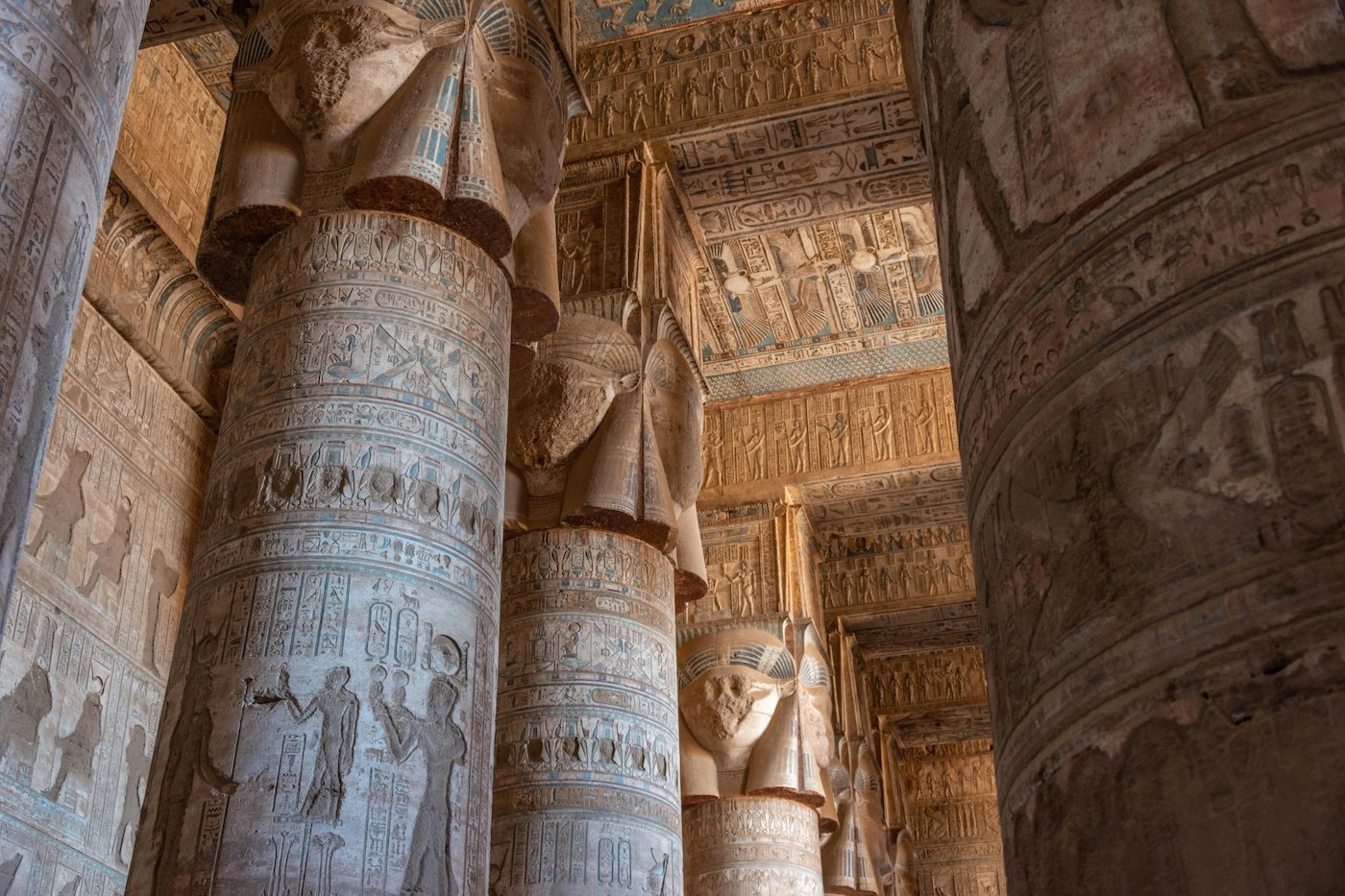
Nothing quite prepares you for the moment you step into the pronaos. Twenty-four columns rise in four rows of six, and each is crowned with the face of Hathor on all four sides, so that the goddess watches you from every direction at once. Many of the faces were deliberately damaged in antiquity, yet the effect remains overwhelming.
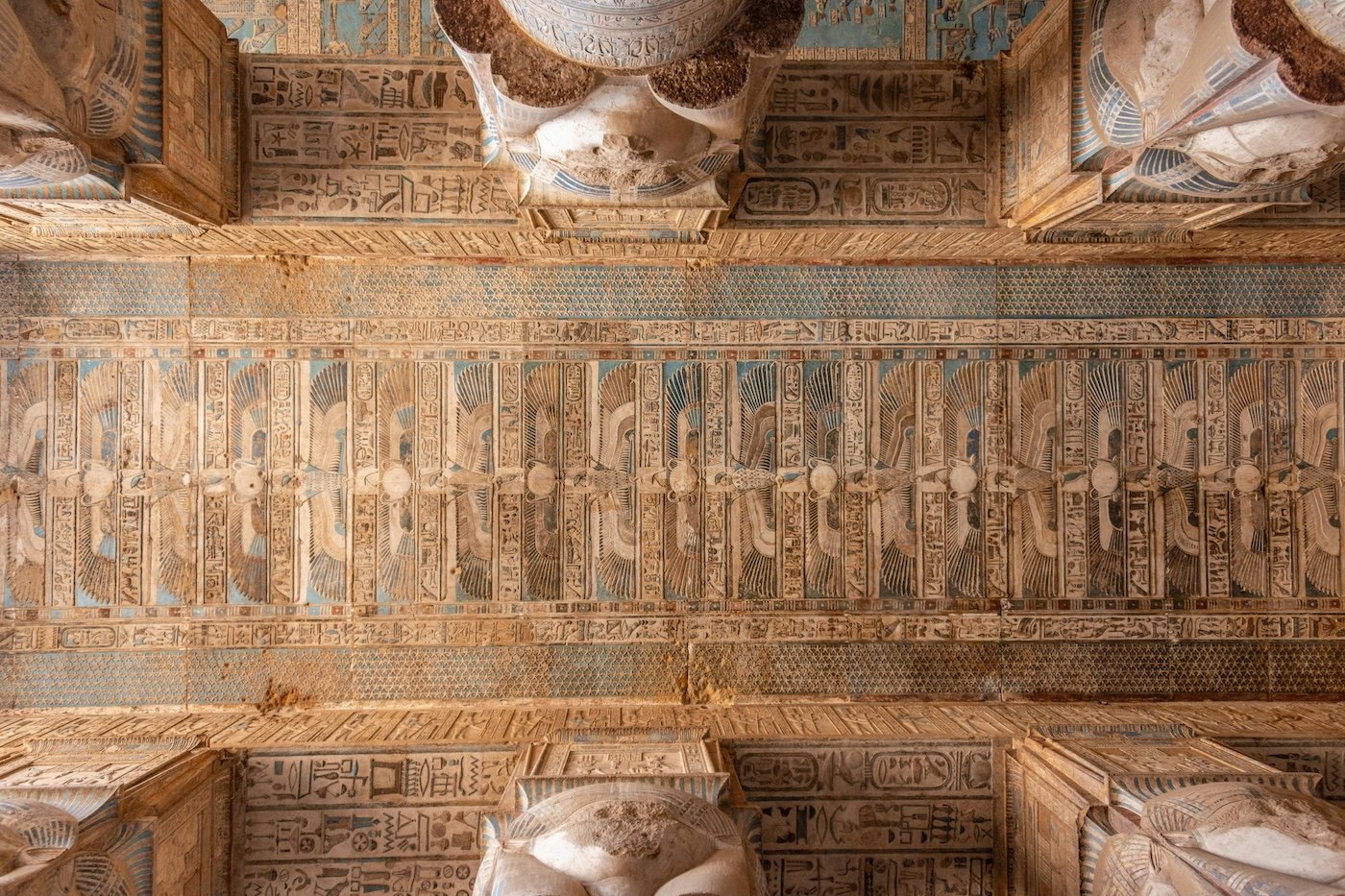
Above you stretches one of the greatest surviving works of ancient astronomy and art. The ceiling is divided into seven long bands filled with winged sun discs, sacred barques sailing across the heavens, the twelve hours of the day and night, the decans that the Egyptians used to tell time by the stars, the five known planets, and the elongated body of the sky goddess Nut arching across the whole composition, swallowing the sun each evening and giving birth to it each dawn.
For centuries all of this was invisible under a thick crust of black soot. A long conservation campaign by the Supreme Council of Antiquities, resumed in 2017 after earlier phases, removed the deposits with paper compresses and fine hand tools. What emerged astonished even specialists: deep lapis blues, warm reds and gilded yellows that look, as one restorer put it, freshly applied. Dendera is now one of the very few places where you can understand what an Egyptian temple interior actually looked like when it was in use.
The walls below are covered in dense columns of text and offering scenes. If you have ever wanted to see Egyptian hieroglyphics at their most refined and most legible, this is the place: the carving here is unusually crisp, and the late date means the signs are often elaborately detailed.
The Dendera Zodiac, and where the original hangs today
The single most famous object ever found at Dendera is the circular zodiac that once formed the ceiling of a small chapel dedicated to Osiris on the temple roof. It is a planisphere, a flat map of the sky, showing the constellations of the zodiac alongside traditional Egyptian decans and the figures of the planets, carried by figures of goddesses and falcon-headed spirits.
Vivant Denon, travelling with Napoleon’s expedition, came upon it in 1799 and drew it lying on his back by candlelight. Its publication caused a sensation in Europe, where it triggered a fierce argument, later nicknamed the Dendera Affair, about the true age of Egyptian civilisation. Jean-François Champollion correctly dated it to the Greco-Roman period, against contemporaries who insisted it was thousands of years older.
In 1821 the antiquities dealer Sébastien Saulnier had the ceiling cut out of the chapel with saws, jacks and gunpowder and shipped to France. It was installed in Paris the following year and has been in the Louvre since 1922. What you see on the chapel ceiling at Dendera today is a cast of the original, deliberately darkened to match the soot-stained surroundings. Egypt has repeatedly requested the return of the authentic relief.
Crypts, staircases and the temple roof
Dendera has twelve crypts hidden within the thickness of its walls and beneath its floors, used to store the temple’s most precious cult statues and ritual equipment. Three have been restored and opened to visitors, and the carving inside them is among the finest on the entire site, protected from weather and from the soot above.
One crypt relief has become an internet legend. It shows the god Harsomtus in the form of a serpent emerging from a lotus flower, enclosed in a long oval and supported by a djed pillar and a kneeling figure. A popular theory claims this depicts an ancient electric lamp, the so-called Dendera light. The accompanying hieroglyphic text, however, names the figures and describes the creation of the god from the primeval lotus. It is a creation scene, and a beautiful one, rather than an engineering diagram.
Two staircases lead to the roof, one straight and one spiralling, and their walls carry reliefs of the New Year procession: priests climbing in file, carrying the goddess upward so that her statue could be united with the rays of the rising sun in an open kiosk. Walking those same steps while looking at carvings of people doing exactly that is one of the most memorable experiences in Egypt. From the top you get wide views over the enclosure, the mudbrick wall and the fields beyond.
Cleopatra on the back wall
Walk around to the rear exterior wall of the temple and you will find a monumental relief of Cleopatra VII standing with her son Caesarion, whose father was Julius Caesar, making offerings to the gods of Dendera. It is one of very few surviving representations of the last queen of Egypt on an Egyptian temple.
Do not expect a portrait. The figure follows the strict conventions of Egyptian royal art, and it tells us how Cleopatra wished to be seen by her Egyptian subjects: not as a Greek ruler, but as a legitimate pharaoh presenting offerings in the ancient manner. For many visitors this quiet corner of wall is the highlight of the whole trip.
The rest of the complex: mammisi, basilica and sacred lake
The Temple of Hathor dominates the site, but it is far from alone inside the enclosure wall.
- Two birth houses (mammisi). One was built by Nectanebo I in the fourth century BC, the other under Roman rule. Both celebrate the birth of the divine child Ihy, and the Roman example keeps lively carvings of the god Bes, protector of mothers and infants.
- A Coptic basilica. Built in the fifth century AD from reused temple stone, it is one of the earliest surviving churches in Egypt and a vivid reminder that the site remained sacred long after the old gods were abandoned.
- The sanatorium. Pilgrims seeking healing slept here and bathed in water poured over inscribed healing statues, an ancient practice that bridges medicine and religion.
- The sacred lake. A fine stone-lined basin, now filled with palm trees, that once supplied the temple’s ritual water.
- A small Temple of Isis behind the main building, plus the Roman gates of Domitian and Trajan in the enclosure wall.
Allow time for all of it. Visitors who rush straight in and out of the hypostyle hall miss roughly half of what makes Dendera special.
Dendera Temple tickets and opening hours
Entry is ticketed by the Ministry of Tourism and Antiquities, and the roof and the crypts are sold as separate add-ons. The figures below reflect the official 2026 price list.
| Ticket | Adult | Student |
|---|---|---|
| Dendera Temple (main complex) | 300 EGP | 150 EGP |
| Panorama (temple roof) | 100 EGP | 100 EGP |
| Catacombs (crypts) | 100 EGP | 100 EGP |
Opening hours: daily from 07:00 to 17:00, with last entry around 16:00. Tickets can be bought at the gate or in advance through the official portal at egymonuments.com. Card payment is accepted at many sites, but it is sensible to carry Egyptian pounds as well. Budget at least an hour and a half, and closer to two and a half hours if you want the roof, the crypts and the outer buildings.
How to get to Dendera from Luxor
Almost everyone visits Dendera as a day trip from Luxor. The drive north follows the Nile and takes about an hour and a half in each direction. A private car with a driver and an Egyptologist guide is by far the most practical option, because there is no useful public transport to the gate and the site rewards explanation.
Our Abydos and Dendera day trip from Luxor covers both sites in one day with transport, entrance arrangements and a licensed guide. Travellers based on the Red Sea coast can reach Luxor and its temples on a private Luxor day trip from Hurghada. Some itineraries also call at Dendera by water: a few Nile cruise itineraries extend north of Luxor to the temple’s own quay.
Best time to visit
Leave Luxor early. Arriving close to opening means cooler air, softer light and far fewer people in the hypostyle hall. The pleasant season runs from October to April; in high summer the drive and the open courtyards are genuinely hot, although the interior stays cool and shaded. Fridays and public holidays bring more domestic visitors.
Photography tips
The interior is dark and the ceiling is high, so raise your ISO and brace the camera rather than relying on flash, which flattens the colour you came to see. The Hathor columns photograph best in the morning when light rakes in through the front screen walls. A separate permit is normally required for tripods and professional equipment.
Why combine Dendera with Abydos
Abydos lies further north, and the two sites pair naturally into one long and rewarding day. Abydos is home to the Temple of Seti I, whose painted raised reliefs are often called the finest carving to survive from ancient Egypt, along with the Abydos King List, a wall recording the names of seventy-six earlier pharaohs, and the mysterious Osireion behind the temple.
Together they offer a rare contrast: Abydos at the height of New Kingdom artistry in the thirteenth century BC, and Dendera more than a thousand years later, at the close of the pharaonic tradition. Few day trips in Egypt cover so much time in so few kilometres.
Frequently asked questions about Dendera Temple
Is Dendera Temple worth visiting?
Yes. Dendera is the best-preserved temple complex in Egypt, with an intact roof, restored colour on its astronomical ceiling, accessible crypts and a relief of Cleopatra VII. It also receives far fewer visitors than the main Luxor sites, so the experience is calmer.
How far is Dendera Temple from Luxor?
Roughly 60 to 75 kilometres north of Luxor, near Qena, which is about an hour and a half by road each way.
Can you still see the Dendera Zodiac at the temple?
You can see a full-size cast in its original position on the ceiling of the Osiris chapel on the roof. The authentic relief was removed in 1821 and has been displayed in the Louvre in Paris since 1922.
What is the Dendera light?
It is a relief in one of the crypts showing the god Harsomtus as a serpent rising from a lotus flower. Fringe theories read it as an electric lamp, but the hieroglyphic text carved beside it identifies the scene as a creation myth.
How long do you need at Dendera Temple?
Allow 90 minutes for the main temple, or about two and a half hours to include the roof, the crypts, the birth houses, the Coptic basilica and the sacred lake.
Who built Dendera Temple?
The standing Temple of Hathor was begun around 54 BC under Ptolemy XII and completed by Roman emperors, with the pronaos finished under Tiberius. It stands on a site used for worship since the Old Kingdom.
Plan your visit to Dendera
Dendera is the temple that shows you what the others have lost: the colour, the roof, the ceiling and the quiet. Pair it with a day in Luxor and you will have seen Egyptian temple architecture from both ends of its long history.
- Abydos and Dendera day trip from Luxor – both temples in one guided day
- Luxor full-day tour, East and West Bank – Karnak, Luxor Temple and the Theban necropolis
- 3-day Nile cruise adventure – sail between Luxor and Aswan with guided temple visits
Continue exploring Egypt’s great sanctuaries with our guides to Luxor Temple, Karnak Temple, the Valley of the Kings and the Temple of Hatshepsut.
Useful links and sources
- Official entrance fees and online tickets for Egyptian monuments: Ministry of Tourism and Antiquities portal
- The original Dendera Zodiac on display in Paris: Musée du Louvre
Ticket prices and opening hours are set by the Egyptian Ministry of Tourism and Antiquities and are reviewed periodically. The figures above reflect the published 2026 rates; please confirm before travelling.