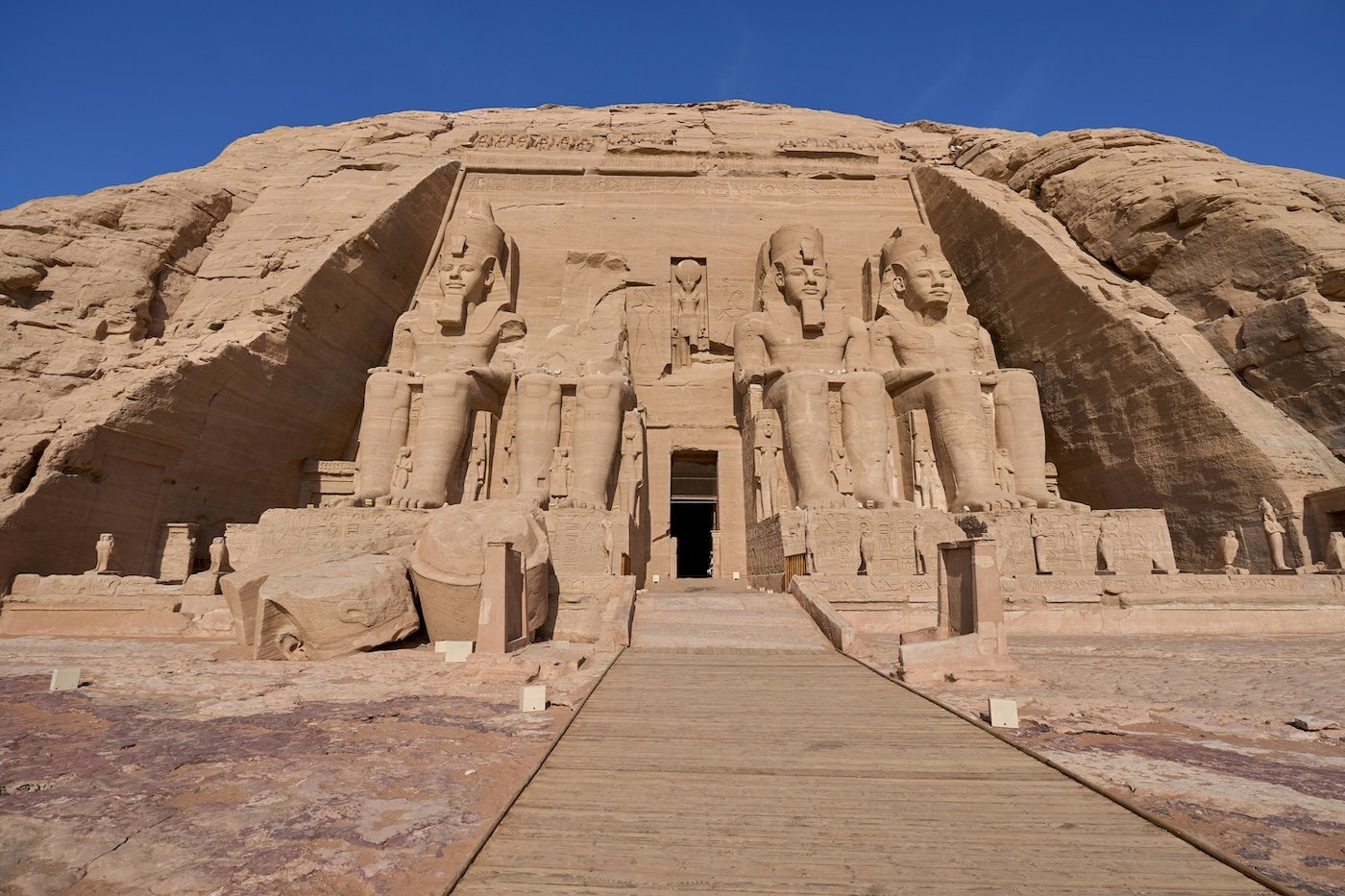
Nothing in Egypt announces itself quite like Abu Simbel. Four seated figures of Ramesses II, each about twenty metres tall, stare out across Lake Nasser from a cliff face near the Sudanese border. Behind them the rock opens into halls that run more than sixty metres into the mountain. And the whole thing, every block of it, stands about sixty-five metres higher than where it was carved, because in the 1960s the world took the temples apart and put them back together out of reach of the rising water.
That combination is what makes Abu Simbel unlike anywhere else: a monument built to overwhelm, and a rescue that is arguably as remarkable as the temples themselves. This guide covers who built them and why, what to look for inside both temples, the twice-yearly sun alignment, and the practical side of visiting in 2026 – tickets, opening hours and how to get there from Aswan.
Where is Abu Simbel?
Abu Simbel sits in the far south of Egypt, on the western shore of Lake Nasser in Aswan Governorate, close to the Sudanese border. From Aswan it is roughly 280 to 300 kilometres by road, which works out at about three and a half hours each way, or around 45 minutes by air.
That remoteness is not incidental. This was Nubia, the land upstream of the First Cataract, and the temples were placed here deliberately, at the southern edge of Egyptian control, where anyone arriving from the south would meet them first.
Who built Abu Simbel, and why
The temples were cut into the sandstone cliff for Ramesses II of the Nineteenth Dynasty, with work running through the middle decades of the thirteenth century BC. There are two of them: the Great Temple, dedicated to Ra-Horakhty, Amun-Ra, Ptah and to the deified Ramesses himself, and the Small Temple a short distance to the north, dedicated to the goddess Hathor and to Ramesses’ queen, Nefertari.
The purpose was never subtle. Egypt had long contested Nubia, the route by which gold, ivory and incense reached the Nile Valley. A temple carved into a mountain, fronted by four colossal images of the living king, made the point without a word being spoken. Ramesses placed himself among the great state gods and had the whole arrangement cut into bedrock so that it could not be dismantled, defaced or carried away. It is propaganda at the scale of geology.
The Great Temple: facade, hall and sanctuary
The facade stands around thirty metres high and thirty-five metres wide. The four seated colossi of Ramesses are each about twenty metres tall, and the second from the left lost its head and shoulders in antiquity, probably in an earthquake; the fallen pieces were reassembled at the feet of the statue during the modern rescue, and left exactly as they were found.
Look down at the legs of the colossi and you will find the rest of the family carved at a fraction of the size: Nefertari, the king’s mother Mut-Tuy, and a long row of royal sons and daughters. Above the doorway stands Ra-Horakhty, the falcon-headed sun god, in a niche cut into the facade.
Inside, the temple drives deep into the rock. The first hall is lined with standing Osiride figures of the king, and its walls carry one of the most famous battle narratives in Egyptian art: the Battle of Kadesh, fought against the Hittites, told here entirely as a personal triumph for Ramesses. The halls narrow as you go, floor rising slightly, until you reach the sanctuary at the very back, where four seated gods share a bench – Ptah, Amun-Ra, the deified Ramesses II and Ra-Horakhty.
The reliefs reward slow looking. If you want to make sense of the texts running across every surface, our guide to Egyptian hieroglyphics is a useful primer before you travel.
The sun festival: 22 February and 22 October
Twice a year the rising sun shines straight down the axis of the Great Temple, through sixty-odd metres of rock-cut hall, and lands on the gods seated in the sanctuary. The dates are 22 February and 22 October. Ptah, god of the underworld, sits at the left-hand end and is traditionally said to remain in shadow.
It has often been suggested that the two dates mark the king’s birth and his coronation, though this is interpretation rather than established fact. What is not in doubt is the engineering: the alignment survived the temple being cut up and rebuilt in a different place, which tells you how precisely the rescue was measured.
If you plan to be there for it, book early and expect company. Ticket prices rise on both dates and the site fills before dawn.
The Small Temple: Nefertari as a goddess
About ninety metres to the north stands the second temple, roughly twelve metres high and twenty-eight metres long, dedicated to Hathor and to Queen Nefertari. Six standing colossi front it: four of Ramesses and two of Nefertari.
The detail that matters is their size. Egyptian convention showed queens at a fraction of the king’s scale, often reaching no higher than his knee. Here Nefertari stands at the same height as Ramesses, flanked by their children. It is a deliberate break with the rules, and the dedication text is equally direct, describing the temple as built for the queen “for whose sake the very sun does shine”.
Inside, Hathor columns line the hall and the walls show the royal couple making offerings. Hathor was the goddess of love, music, joy and motherhood, and Nefertari appears here in her role. If that pairing interests you, her great sanctuary downstream is the subject of our guide to Dendera Temple, the best-preserved temple complex in Egypt.
Buried, forgotten, found
Abu Simbel did not survive by being looked after. It survived by being buried. Desert sand drifted across the facade for centuries; by the sixth century BC it already covered the colossi up to the knees, and eventually only a frieze and the head and shoulders of one statue remained above the surface.
In 1813 the Swiss traveller Johann Ludwig Burckhardt came across the site and could not clear it. He told the Italian strongman and excavator Giovanni Belzoni, who tried and failed in 1816, returned the following summer, and after twenty-two days of digging finally entered the Great Temple on 1 August 1817. The name Abu Simbel is said to come from a local boy who led one of them to the spot; it is not the ancient name of the place.
The rescue: cutting a mountain into pieces
In the late 1950s Egypt began building the Aswan High Dam. The reservoir behind it, Lake Nasser, would drown a long stretch of Nubia and everything standing in it, Abu Simbel included. Egypt and Sudan appealed to UNESCO in 1959, and what followed became the International Campaign to Save the Monuments of Nubia.
Work on Abu Simbel began in 1964. Engineers and archaeologists cut both temples into more than a thousand numbered blocks, many of them around thirty tons, lifted them clear, and rebuilt the whole complex on the clifftop above: roughly sixty-five metres higher and some two hundred metres further inland, inside an artificial mountain built of concrete domes and then covered over so that the temples would once again appear to be cut from living rock. The relocated temples were inaugurated on 22 September 1968, at a cost for Abu Simbel alone of around forty million dollars.
The same campaign saved the island temples of Philae near Aswan, dismantled and rebuilt on Agilkia island between 1972 and 1980. Seeing both on one trip gives you the full story, and our guide to Philae Temple covers the other half of it. The Nubian Monuments from Abu Simbel to Philae were inscribed on the UNESCO World Heritage List in 1979.
One footnote worth knowing: the campaign moved stones, but it also moved people. Tens of thousands of Nubians were resettled when Lake Nasser filled, and their villages, language and traditions are a living part of Aswan today. Our guide to the Nubian village in Aswan is worth reading alongside this one.
Abu Simbel tickets and opening hours in 2026
One ticket covers both temples. Be aware that two official Egyptian sources currently publish different figures: the Ministry of Tourism and Antiquities information page and the official online booking portal do not match. Both are genuine, so budget for the higher one and check your own date before paying.
| Ticket | Ministry page | Online portal |
|---|---|---|
| Foreign adult, standard day | 750 EGP | 822 EGP |
| Foreign student, standard day | 375 EGP | 445.50 EGP |
| Adult, 22 Feb / 22 Oct | 1,200 EGP | 1,272 EGP |
Opening hours: the Ministry lists the site as open daily from 06:00 to 17:00, while the ticket portal gives 16:00 as the last entry. Hours are reported to shift during Ramadan, so check if you are travelling then. Children under six generally enter free, and students need a valid international student card.
Paying: since 2023 the major Egyptian sites take card payment at the ticket office rather than cash, so bring a card that works abroad. Tickets can also be bought in advance through the official portal at egymonuments.com. Many organised day trips include the entrance fee, but not all of them do – check before you book.
How long do you need?
Allow an hour and a half to two hours for both temples at a civilised pace, and closer to three if you want to sit with the facade for a while and walk round the back of the artificial hill, where you can see the domes that hold the whole thing up. That rear view is one of the most interesting things on the site and most visitors miss it entirely.
How to get to Abu Simbel from Aswan
Almost everyone comes from Aswan, and there are two realistic ways to do it.
- By road. Around three and a half hours each way across the desert, usually leaving before dawn so that you reach the temples in the cool of the morning. It makes for a long day, but it is the most common and most affordable option.
- By air. Roughly 45 minutes from Aswan. Flights are timed so you land, visit and fly back, which turns the whole thing into a half-day at considerably more cost.
Our Abu Simbel day tour from Aswan handles the early start, the drive and a licensed Egyptologist at the temples. If you would rather combine Abu Simbel with the rest of what Aswan does well, the Aswan day tour with Abu Simbel and Nubian highlights adds the island temples and the Nubian south. Travellers arriving by water on a Nile cruise usually add Abu Simbel as an excursion at the Aswan end of the itinerary.
Best time to visit
October to April is the comfortable season this far south; summer at Abu Simbel is genuinely punishing, and the site has very little shade. Early morning is best in any month – cooler, better light on the east-facing facade, and the tour convoys have not all arrived yet. The two sun festival mornings are the exception to every rule: spectacular, crowded, and more expensive.
Photography
The facade takes the morning sun straight on, so it photographs well early. Inside the temples the rules on cameras and flash change from time to time and are enforced at the door, so ask rather than assume. A wide lens helps more here than anywhere else in Egypt; nothing at Abu Simbel fits comfortably in a normal frame.
Frequently asked questions about Abu Simbel
Is Abu Simbel worth the long trip from Aswan?
For most visitors, yes. It is the largest and most theatrical rock-cut monument in Egypt, and the story of how it was moved adds a second layer that no other site has. The drive is long, but the temples are not something you can approximate anywhere else.
Who built Abu Simbel?
Ramesses II of the Nineteenth Dynasty, in the thirteenth century BC. The Great Temple honours Ra-Horakhty, Amun-Ra, Ptah and Ramesses himself; the Small Temple honours Hathor and Queen Nefertari.
Was Abu Simbel really moved?
Yes. Between 1964 and 1968 both temples were cut into more than a thousand blocks and rebuilt about sixty-five metres higher and some two hundred metres further from the water, inside a purpose-built artificial hill. The relocated site opened on 22 September 1968.
When is the Abu Simbel sun festival?
22 February and 22 October. The rising sun reaches down the axis of the Great Temple and lights the statues in the sanctuary. Tickets cost more on both dates and the site is very busy.
How much are Abu Simbel tickets?
In 2026 the Ministry information page lists 750 EGP for foreign adults and 375 EGP for students, while the official booking portal lists 822 EGP and 445.50 EGP. Both are official; check the live price for your date.
Plan your visit to Abu Simbel
Abu Simbel asks for an early alarm and a long road, and gives back the single most overwhelming facade in Egypt plus one of the great engineering stories of the twentieth century. Build it into your Aswan days rather than treating it as an afterthought.
- Abu Simbel day tour from Aswan – early start, private transport and a licensed guide
- Aswan day tour: Abu Simbel and Nubian highlights – the temples plus the best of the south
- 3-day Nile cruise adventure – sail between Luxor and Aswan with guided temple visits
Keep exploring with our guides to Philae Temple, Luxor Temple with its own colossi of Ramesses II, Karnak Temple and the Valley of the Kings.
Useful links and sources
- Official entrance fees and online tickets: Ministry of Tourism and Antiquities portal
- The rescue campaign, in UNESCO’s own words: Working Together: Abu Simbel
Ticket prices and opening hours are set by the Egyptian Ministry of Tourism and Antiquities and are reviewed periodically. The figures above reflect the rates published for 2026; please confirm before travelling.